AI for Entrepreneurs
The 16 building blocks of an AI-driven business.
Everything below is something you can learn in an afternoon and use for the life of your business. We've grouped it into four categories — the technical foundations, the AI layer that sits on top, the business essentials that turn a project into a company, and the legal and operational foundations that make it real.
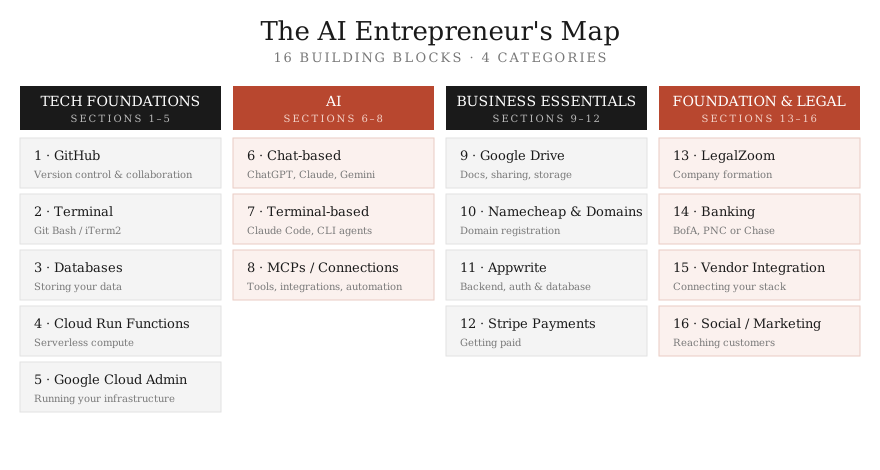
Tech Foundations
Sections 1–5 · The plumbing every modern business runs on.
1 · GitHub
GitHub is the home for your code and the single source of truth for everything you build. Even as a solo founder, it gives you version history (so you can never permanently break your own work), a place to collaborate the moment you bring on help, and a one-click path to deploy a website or function to the internet. It is essential because it turns "files on my laptop" into a durable, shareable, recoverable asset — the foundation that almost every other tool on this list plugs into.
- BeginnerGitHub: Hello World
- Intermediate / AdvancedGitHub Flow & branching
2 · Terminal (Git Bash / iTerm2)
The terminal is the command line — a text window where you talk to your computer and your servers directly. It feels intimidating for about a day, and then it becomes the fastest way to do almost anything: install tools, run your code, push to GitHub, and drive the AI coding agents covered later in this guide. On Windows you'll use Git Bash; on a Mac, the built-in Terminal or the more capable iTerm2. It's essential because every serious tool assumes you can run a command, and learning it once unlocks all of them.
- BeginnerGit: the command line
- Intermediate / AdvancediTerm2 documentation
3 · Databases
A database is where your business remembers things — customers, orders, sign-ups, content. Unlike a spreadsheet, it can be queried, secured, and read by your website and functions at the same time without falling over. Understanding the basics (tables, rows, and simple queries) is essential because the moment your product does anything real, it needs to store and retrieve data reliably. You don't need to be a database administrator; you need to know enough to model your data and trust where it lives.
- BeginnerPostgreSQL tutorial
- Intermediate / AdvancedPostgreSQL: the SQL language
4 · Cloud Run Functions
Cloud Run functions (and serverless functions generally) let you run a piece of code on demand without owning or managing a server. Someone fills out a form, a payment clears, a schedule ticks over — your function wakes up, does its job, and you only pay for the seconds it ran. This is essential for a lean business because it lets one founder ship real backend logic — emails, webhooks, data jobs — with no infrastructure to babysit and costs that start at effectively zero.
- BeginnerCloud Run quickstarts
- Intermediate / AdvancedWriting functions for Cloud Run
5 · Google Cloud Administration
Google Cloud (GCP) is the control room behind your functions, databases, and storage — and knowing how to administer it means managing projects, permissions, billing, and access without locking yourself out or leaving the door open. It's essential because cloud mistakes are the ones that cost real money or leak real data. A little fluency with the console, IAM roles, and billing alerts protects you on both fronts and lets you grant access safely as your team grows.
- BeginnerGet started with Google Cloud
- Intermediate / AdvancedIdentity & Access Management (IAM)
AI
Sections 6–8 · The leverage layer — the building blocks for everything that follows.
6 · Chat-based AI
Chat-based AI — ChatGPT, Claude, Gemini — is the front door for most people. You type or paste, and it writes, explains, summarizes, or plans. In the workflow of building a business it's the all-purpose drafting partner: it writes the first version of your website copy, turns rough notes into a polished email to a prospect, drafts a meeting invite, and summarizes a long thread into the three follow-ups you actually owe people. The skill is not "asking questions" — it's giving good context and iterating, treating the model like a fast, tireless junior teammate.
For an entrepreneur, chat AI is where ideas become artifacts. You can have it outline the structure of a website before a single line of code, draft the email sequence that follows a sales call, or convert a signed-deal conversation into a clean PDF cover note. Everything in the Business Essentials section below — your site, your customer communications, your follow-ups — starts as a chat-based draft. Master this first, because the terminal-based and connected tools that follow are the same intelligence with more reach.
- BeginnerAnthropic: learn to use Claude
- Intermediate / AdvancedPrompt engineering guide
7 · Terminal-based AI
Terminal-based AI — agentic coding tools like Claude Code — lives in the command line you learned in section 2 and can actually do things: read your project, write and edit files, run commands, and ship changes to GitHub. Instead of copying snippets out of a chat window, you describe what you want — "add a contact form, wire it to the database, deploy it" — and the agent works directly in your codebase. For building a website or a backend function, this collapses hours of manual work into a conversation.
The reason this matters for a founder is leverage without headcount. The same tool that builds your website can also write the function that emails a customer, generate the script that organizes your follow-ups, or assemble the PDF you need someone to sign. It is the bridge between "I have an idea" and "it's live," and it's why one technically curious person can now operate like a small team. Chat AI drafts; terminal AI builds and deploys.
- BeginnerClaude Code overview
- Intermediate / AdvancedClaude Code: common workflows
8 · MCPs & Connections
MCP — the Model Context Protocol — and connections more broadly are how AI reaches out of the chat box and into the tools you already use. With the right connection, your AI can read and send email, put a meeting invite on your calendar, drop a file in your drive, look up a customer, or send a PDF out for signature — all from a single instruction. This is the step that turns a smart assistant into an operator that works across your stack.
For an AI-driven business this is the multiplier. Writing email communications, sending meeting invites, organizing follow-ups, and sending PDFs to sign all stop being separate manual chores and become one connected workflow: "draft the follow-up to everyone from yesterday's calls, book time with the two who replied, and send the agreement to the one who's ready." The Business Essentials below — Drive, payments, your backend — are exactly the kinds of services you connect, so the AI you learned in sections 6 and 7 can act on them directly.
- BeginnerIntroduction to MCP
- Intermediate / AdvancedMCP architecture & concepts
Business Essentials
Sections 9–12 · The services that turn a project into a company.
9 · Google Drive
Google Drive is the shared filing cabinet and writing surface for your business — documents, spreadsheets, slides, and storage that live in the cloud and are always shareable with a link. It's essential because it's where your contracts, financials, and decks live, where you collaborate with anyone in real time, and — increasingly — what your AI connects to in order to read and create files on your behalf. It's the simplest, lowest-friction backbone for running the paperwork side of a company.
- BeginnerGet started with Drive
- Intermediate / AdvancedDrive for teams & sharing
10 · Namecheap & Domain Registration
Your domain is your address on the internet and the anchor of your brand and email. Registering one through a registrar like Namecheap takes minutes and a few dollars a year, and it's the difference between a real business and a free subdomain that looks like a hobby. It's essential early because your domain underpins your website, your professional email, and the trust signals that make customers comfortable paying you.
- BeginnerHow to register a domain
- Intermediate / AdvancedDNS & domain configuration
11 · Appwrite
Appwrite is an all-in-one backend: a database, user authentication (including logins like Google and LinkedIn), file storage, and serverless functions, wrapped in one service you can wire to your website in an afternoon. For a founder it removes the hardest, most error-prone part of building a product — the backend — so you can capture sign-ups, log in users, and store data without standing up your own servers. It's the engine room behind a real, interactive product.
- BeginnerAppwrite quick starts
- Intermediate / AdvancedAppwrite Authentication
12 · Stripe Payments
Stripe is how you get paid. It handles checkout, subscriptions, invoices, and payouts, with the security and compliance you absolutely do not want to build yourself. It's essential because revenue is the point — and Stripe takes you from "people like this" to "people are paying for this" with a few lines of code or a hosted payment link. Once Stripe is live, you have a business, not a project.
- BeginnerStripe payments quickstart
- Intermediate / AdvancedStripe Checkout
Foundation & Legal
Sections 13–16 · Making it real, fundable, and findable.
13 · LegalZoom — Company Formation
Forming an actual legal entity — usually an LLC — separates your business from you personally, protects your assets, and is a prerequisite for a business bank account, contracts, and payments. Services like LegalZoom make incorporation a guided, affordable form instead of a lawyer's bill. It's an essential early step because almost everything else — banking, Stripe, vendor contracts — assumes a real company exists behind it.
- BeginnerLegalZoom: form an LLC
- Intermediate / AdvancedChoosing an entity: LLC vs. corporation
14 · Banking (BofA, PNC, Chase)
A dedicated business bank account is where your company's money lives, cleanly separated from your personal finances — which matters for taxes, bookkeeping, and credibility. Major banks like Bank of America, PNC, and Chase all offer small-business accounts that connect to your payments and accounting tools. It's essential because clean financial separation is non-negotiable once real money moves, and it's far easier to start clean than to untangle later.
- BeginnerChase business checking
- Intermediate / AdvancedBank of America for small business
15 · Vendor Integration
Vendor integration is the work of making your tools talk to each other — your payments to your database, your sign-ups to your email, your forms to your CRM — so your business runs as one system instead of a pile of disconnected accounts. Sometimes this is a native connection, sometimes a webhook, sometimes an automation tool in the middle. It's essential because the value of your stack is in the connections: an integrated business captures every lead and never drops a follow-up; a disconnected one leaks customers at every seam.
- BeginnerIntro to automation & integrations
- Intermediate / AdvancedConnecting services with webhooks
16 · Social & Marketing
Social and marketing is how the world finds out you exist. A clean presence — a business profile, a few channels where your customers actually are, and a simple, consistent message — is what turns a working product into a growing one. It's essential because the best product nobody hears about loses to a decent product with great distribution. You don't need to be everywhere; you need to be findable and credible where your buyers already look.
- BeginnerSet up a Google Business Profile
- Intermediate / AdvancedMeta Business Suite
This guide is a living document — we'll keep refining the explanations and guides. Building something and want to compare notes? Introduce yourself.